

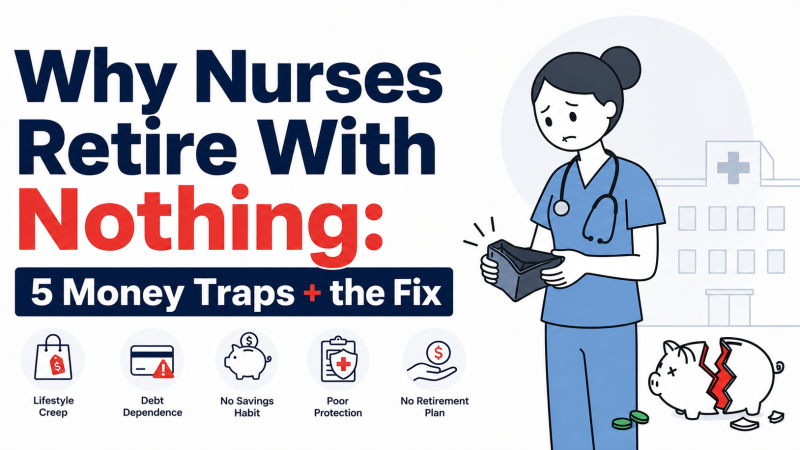
Why Nurses Retire With Nothing: The 5 Money Traps of a Nursing Career (And the Late-Starter Fix)
The average registered nurse in America earns around $90,000 a year. Over a 30-year career, that means more than $2.5 million passes through her hands.
So explain this: by some government estimates, close to half of all households arriving at retirement age have almost nothing saved for it — and nurses, despite out-earning most of the country, are heavily represented in that group.
Two and a half million dollars in. Nearly zero left at 60.
That’s not a spending problem. It’s a system problem — five traps built directly into the structure of a nursing career. I break down all five in the video below, and in this post I’ll go one level deeper than the video could: the exact 2026 numbers for the recovery plan.
Trap 1: The Overtime Treadmill
Nursing is one of the only careers where more money is always available tonight. Car trouble, Christmas, credit card creeping up? Pick up a shift. Time and a half solves it by Friday.
That sounds like an advantage. It’s actually the trap. Because overtime becomes the answer to every financial question, the underlying system never gets built. A teacher with a spending leak hits the wall at 35 and is forced to fix it. A nurse can out-earn the same leak for 25 years — right up until her body stops picking up shifts.
Overtime is a painkiller, not a plan. It doesn’t fix broken finances. It hides them.
Trap 2: The Family Bank
In many families, the nurse is the first person to ever hold a stable professional income. The moment that happens, she stops being a person with a job and becomes the family’s emergency fund. The brother’s rent. Mom’s medication. School fees. She never says no, because saying no feels like a betrayal of the exact reason she became a nurse.
Here’s the quiet math. $500 a month flowing out to family — a conservative figure for many nurses — is $6,000 a year. Over 25 years, that’s $150,000 given away. Invested in a basic retirement account instead, with compound growth, it’s closer to $400,000.
She became everyone’s safety net. Which is exactly why she never got one.
The fix is not cutting your family off. It’s capping the bank: a fixed monthly amount, decided in advance, in writing — generosity with a budget line instead of generosity with a blank check.
Trap 3: The Pension Illusion
Ask a nurse about her retirement plan and you’ll usually hear: “the hospital has something.”
Something. A pension, maybe — except most hospital pensions that older nurses are counting on were frozen or phased out years ago. What replaced them is a 403(b) or 401(k) that only works if you feed it, with an employer match that only pays if you claim it. A nurse still sitting at the default 3% contribution from orientation has been leaving free money on the table every payday for decades.
And nurses change employers a lot — every job change is another chance for a small account to get cashed out, taxed, penalized, and absorbed into daily life.
A benefit you have never logged into is not a plan. It’s a rumor. (If you’re not sure where you stand, my Retirement Calculator takes about ten minutes and will tell you exactly.
Trap 4: The Body Clock
Here’s what separates nursing from nearly every other high-income career: the income is physical. Lifting patients, twelve hours on your feet, night shifts scrambling your health one decade at a time. Nursing carries some of the highest back-injury rates of any profession — higher than construction.
Which breaks the most common nurse retirement plan of all: “I’m behind, but I’ll just keep working and catch up later.” That plan assumes the body cooperates into the mid-60s. For a huge share of nurses, it stops cooperating around 55 — exactly when the catch-up years were supposed to begin.
An accountant’s income is durable. A nurse’s income is leased, and the lease often expires early. Every year the plan waits, it’s betting money that hasn’t been saved on a spine that hasn’t been consulted.
Trap 5: The Start-Over Loop
Because she knows she’s behind, the nurse becomes a serial beginner. A new certification. A side business. A travel contract. An online store that lasted four months. Every January a new plan; every June an abandoned one — because you cannot build a second business in the exhausted hours after a 12-hour shift.
Each restart costs money. Each abandonment costs belief. After enough loops, she concludes she is the problem. She isn’t. The problem is adding more income to a system that leaks instead of fixing the leak.
You don’t need another beginning. You need one boring plan you refuse to quit.
What 30 Years of Traps Looks Like
In the video I tell the story of Brenda — a composite of thousands of real nurses. First shift in 1994. Overtime that furnished the apartment, then bought the brother’s car, then carried the whole family. The 403(b) left at 3% since orientation. One account cashed out in a hard year. Certifications and side businesses in her 40s. Travel-nurse money in her 50s that left as fast as it landed. A back that filed its resignation at 56, shutting off the overtime tap that held the whole structure up.
Brenda turns 60 this year with about $12,000 saved. Thirty years of shifts. $2.5 million earned. Twelve thousand left.
The paycheck was never the problem. Nobody ever told it where to go.
The Late-Starter Fix: The 10-Year Rebuild (2026 Numbers)
Here’s the part that never makes it into the doom content: after 50, the rules change in your favor. The IRS calls them catch-up contributions, and they exist precisely for people like Brenda at the fork. This is where the blog goes deeper than the video — the actual 2026 limits:
Your 403(b)/401(k): the standard employee limit is $24,500 in 2026. At 50+, you can add a $8,000 catch-up — $32,500 total. From ages 60–63, the “super catch-up” raises that to $11,250 extra, or $35,750 total per year. (Full breakdown in my post on [the $35,750 retirement shortcut → /catch-up-contributions-2026].)
Your IRA on top: roughly another $8,000+ per year at 50+, on top of the workplace plan.
A realistic nurse’s version doesn’t require maxing everything. The rebuild looks like this:
- Cap the family bank — fixed amount, in writing, effective this month.
- Log into the account you’ve been ignoring and raise your contribution to capture 100% of the employer match. That’s an instant, guaranteed return no investment can beat.
- Redirect the overtime. Same shifts you’re already working — but the money now has a destination: filling catch-up room instead of plugging leaks.
- Protect the asset. Move toward the nursing roles that spare your body — case management, telehealth, education, outpatient. In this plan, your spine is the pension.
A nurse who runs this from 50 to 60 — even imperfectly — arrives at retirement in a completely different position than 30 years of unplanned earning ever produced. Not because the math is magic. Because for the first time, the money that came in was told where to go.
Want the full plan on paper? The [Late-Starter Retirement Action Plan → GUMROAD LINK] is the exact 10-year rebuild from this video, worksheet included — built for people starting in their 40s, 50s and 60s.
FAQ
Do nurses get a pension? Some do — but most hospital pensions were frozen or replaced by 403(b)/401(k) plans over the past two decades. If you were hired after the mid-2000s, assume you’re in a contribution plan that only grows if you fund it, and verify what you actually have this week.
Is 50 too late to start saving for retirement as a nurse? No — and 50 is exactly when catch-up contributions unlock. A nurse saving aggressively from 50 to 60 during her peak earning years can build a six-figure foundation from a standing start. Late is a disadvantage. It is not a disqualification.
How much should a nurse have saved for retirement by 60? Common benchmarks suggest several times your salary by 60 — but if you’re reading this far behind that number, benchmarks are noise. The useful question isn’t “where should I be?” It’s “what’s the maximum I can capture in the next 10 years?” Start with the match, then the catch-up limits.
What if my body won’t make it to 65 in bedside nursing? Plan for that now, not at the injury. The transition into case management, telehealth, or education roles typically costs some hourly pay but extends your earning years — and total years earned beats peak rate every time.



Leave a Reply