

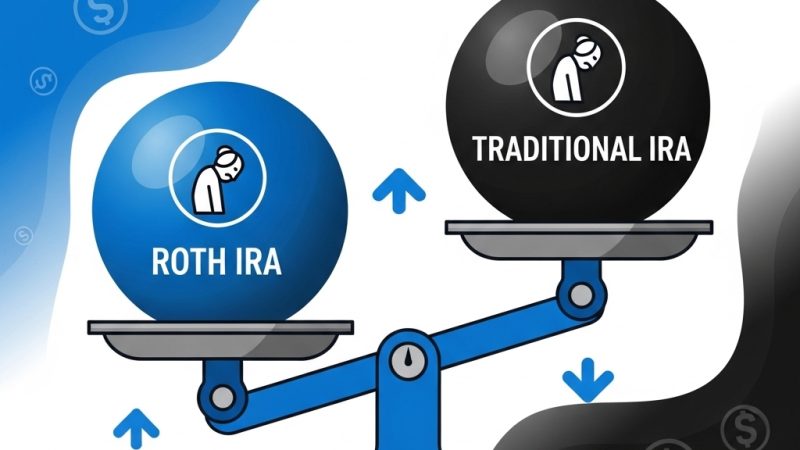
The Question That Has a Different Answer in Your 50s
If you search Roth IRA vs Traditional IRA, most of what you’ll find is written for 28-year-olds. The advice is usually: if you expect to be in a higher tax bracket in retirement, go Roth. If you expect a lower bracket, go Traditional.
For someone in their 50s — whether you’re comfortably on track or frantically trying to close a gap — that framework is incomplete. At this stage, the decision involves RMD exposure, Roth conversion windows, Social Security tax torpedo risk, estate planning, and the real possibility that tax rates go up before you retire. The stakes are higher. The nuances are more consequential.
Let’s work through the full picture.
The Core Difference: When You Pay the Tax
Both accounts let your money grow without being taxed annually. The difference is when the tax hits.
With a Traditional IRA, you contribute pre-tax dollars — meaning you get a tax deduction today. The money grows tax-deferred. When you withdraw in retirement, every dollar comes out as ordinary income and gets taxed at whatever rate applies then.
With a Roth IRA, you contribute after-tax dollars — no deduction today. The money grows tax-free. Qualified withdrawals in retirement are completely tax-free, including all the growth.
The simple version of the debate: if your tax rate will be higher in retirement than it is now, Roth wins. If your tax rate will be lower in retirement, Traditional wins.
The problem is that predicting your future tax rate with confidence is genuinely difficult — especially with federal tax cuts currently set to expire, potential Social Security benefit reductions being discussed in Washington, and an unpredictable market that will determine how much income your portfolio generates.
Why This Gets More Complex After 50
Required Minimum Distributions
Starting at age 73, the IRS requires you to withdraw a minimum amount from your Traditional IRA every year — whether you need the money or not. These are called Required Minimum Distributions, or RMDs. They’re calculated based on your account balance and your life expectancy factor.
Here’s the problem. If you’ve been a diligent Traditional IRA saver for 30 years, your RMDs can be substantial — $40,000, $60,000, $80,000 a year or more. That income is fully taxable. It layers on top of your Social Security, pension, or other retirement income. The combined effect can push you into a higher tax bracket than you expected, trigger surcharges on Medicare premiums, and even cause more of your Social Security to be taxed.
Roth IRAs have no RMDs for the original account owner. The money can sit and grow tax-free for as long as you live, and it passes to heirs tax-free. For people who don’t need all their retirement savings for their own living expenses, this is a significant estate planning advantage.
The Social Security Tax Torpedo
Up to 85% of your Social Security benefit can be taxed if your combined income — including traditional IRA withdrawals — exceeds certain thresholds. For a married couple filing jointly, the threshold at which 50% of Social Security becomes taxable starts at $32,000 in combined income. The full 85% taxation kicks in at $44,000.
This means a traditional IRA withdrawal that pushes you above those thresholds doesn’t just get taxed itself — it also causes more of your Social Security benefit to be taxed. The effective marginal tax rate in this zone can hit 40-45% for people in what’s nominally the 22% or 24% bracket. This is what planners call the tax torpedo — and it blindsides people who never saw it coming.
Roth withdrawals don’t count toward combined income for Social Security taxation purposes. Having a Roth IRA as a source of tax-free income in retirement gives you a lever to manage your taxable income and stay below the torpedo threshold.
The Roth Conversion Strategy After 50: Using the Gap Years
If you’re 50-62 and still working, you may be in what planners call the conversion window — a period where your income is higher, but you have years before RMDs kick in and before Social Security income begins. This is actually a good time to consider Roth conversions.
A Roth conversion means taking money out of your Traditional IRA, paying income tax on it today, and moving it into a Roth IRA where it grows tax-free from that point on.
The strategic logic: if you expect your income to drop between retirement and when you claim Social Security, those lower-income years create an opportunity to convert Traditional IRA money at a lower tax rate than you’d otherwise face through RMDs.
Meet Carol, 58, recently retired early with $600,000 in a Traditional IRA. She’s not yet claiming Social Security. Her income right now is very low — maybe $30,000 a year from part-time work. She’s in the 12% bracket. If she converts $30,000 of her Traditional IRA to Roth each year for five years, she moves $150,000 out of future RMD exposure at a 12% rate. When her RMDs kick in at 73, she has a smaller Traditional IRA balance — meaning smaller forced withdrawals, lower tax exposure, and more flexibility.
Income Limits: Who Can Use a Roth IRA Directly
One catch: direct Roth IRA contributions are subject to income limits. In 2026, for single filers, the ability to contribute to a Roth IRA starts phasing out at $165,000 of modified adjusted gross income and disappears entirely above roughly $180,000. For married filing jointly, the phase-out starts at $246,000.
If you’re above those limits, you can’t contribute directly to a Roth IRA. But you can use a backdoor Roth IRA — contributing to a non-deductible Traditional IRA and then converting it to Roth. This is a legal, widely used strategy, but it requires careful handling to avoid the pro-rata rule, which can create unexpected tax consequences if you have existing pre-tax IRA money.
For most people in their 50s earning under $165,000 individually or $246,000 jointly, the direct Roth IRA contribution is available and worth using alongside the Traditional IRA.
The Side-by-Side Decision Framework
| Situation | Lean Traditional | Lean Roth |
| Current tax bracket | High (24%+) | Low-moderate (12-22%) |
| Expected retirement bracket | Lower | Same or higher |
| RMD concern | No | Yes — large balance |
| Social Security timing | Delaying past 70 | Claiming at 62-67 |
| Estate planning goal | Spend it all yourself | Leave to heirs |
| Employer match available | Always max match first | Always max match first |
The Answer Nobody Wants to Hear: Use Both
The honest answer to “Roth vs Traditional after 50” is that for most people in this situation, the right answer is a combination of both — not a binary choice.
Max out your employer-sponsored plan (Traditional 401(k) or Roth 401(k) depending on your bracket) to capture the full employer match. Contribute to a Roth IRA separately if you’re within income limits. Consider Roth conversions strategically in lower-income years. The goal is tax diversification — having buckets in both taxable and tax-free status so you can manage your income in retirement with precision.
The people who arrive at retirement with everything in Traditional IRAs have no flexibility. Every dollar they spend is taxed. Every RMD is taxed. Every Social Security dollar that gets pushed into the taxable zone is taxed. Tax diversification is the retirement equivalent of asset diversification — it gives you options when the environment changes.
The Late Saver’s Advantage
There’s one thing that often goes unsaid about this debate for late savers: the time horizon is actually an advantage when it comes to Roth.
If you’re 50 and you put $8,600 into a Roth IRA this year, that money has 15 to 20 years to grow tax-free before you’re likely to need it. At 7% annual return, $8,600 becomes approximately $32,000 by the time you’re 70 — all of it completely tax-free on withdrawal. The tax-free compounding still works even when you start late.
The Roth IRA isn’t just for 25-year-olds with 40 years of runway. It’s for anyone who has tax-free growth years ahead of them — and at 50, you still have more of those years than you might think.
The choice between Roth and Traditional IRA after 50 is one of the highest-leverage financial decisions you’ll make in the decade before retirement. Get clarity on your current bracket, your expected retirement income, your RMD exposure, and your estate goals — and then build the account structure that puts you in the best possible position.
Your future self, facing a tax bill in retirement, will thank you for thinking this through now.



Leave a Reply