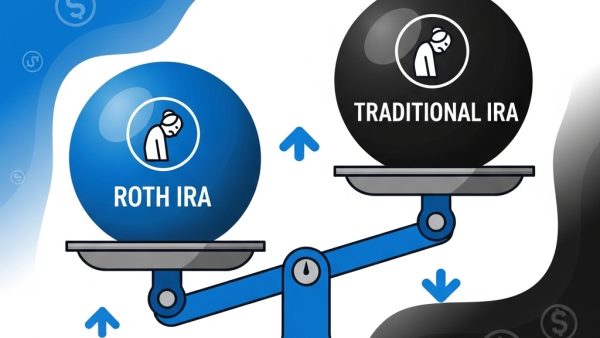


The Tax-Free Retirement Income Strategy Most People Have Never Heard Of
When most people think about retirement income, they picture drawing from their 401(k) or IRA, watching the IRS take its cut, and working with whatever is left. That is the default. It is also, for many people, completely avoidable.
There is a strategy that allows you to systematically move money from your taxable retirement accounts into a completely tax-free environment over a series of years. When you execute it correctly, you arrive at retirement drawing income that the IRS cannot touch. Not because you found a loophole. Because you planned deliberately while everyone else was just accumulating.
It is called the Roth conversion ladder. And while it sounds complex, the mechanics are straightforward once you understand what is actually happening.
Let me walk you through it completely.
The Problem This Strategy Solves
Before we get into the how, it is worth understanding the why. Why do you need a conversion strategy at all?
If you have spent your career contributing to a Traditional 401(k) or Traditional IRA, you have a tax bill coming. Every single dollar sitting in those accounts has never been taxed. The moment you start withdrawing in retirement, it becomes ordinary income. It gets stacked on top of your Social Security, any pension, any other income you have. And if the balance is large enough, the Required Minimum Distributions that kick in at age 73 will force you to take withdrawals whether you need the money or not.
Here is what that looks like in practice. Imagine you are 73 with $900,000 in a Traditional IRA. The IRS requires you to withdraw roughly $34,000 that year based on the life expectancy factor. That $34,000 is taxable income. Add your Social Security, and suddenly you are in a higher bracket than you expected. Your Medicare premiums may increase because of an income-related surcharge. More of your Social Security becomes taxable. The tax torpedo hits without warning.
The Roth conversion ladder is the preemptive strike against this scenario. It works by deliberately converting Traditional IRA or 401(k) money into a Roth IRA during a lower-income window before retirement, paying tax at a rate lower than you would face later, and building a reservoir of tax-free money that you can draw on without triggering any of the above.
How the Five-Year Rule Works
Before explaining the ladder itself, you need to understand the Roth five-year rule because it is the mechanical foundation of the entire strategy.
When you convert Traditional IRA money to a Roth IRA, that converted amount starts its own five-year clock. You can withdraw the converted principal tax-free and penalty-free after five years. If you pull it out before five years have passed, you owe a 10% early withdrawal penalty on the converted amount.
This means the strategy requires planning at least five years ahead of when you need the money. You are building a ladder. Each rung is a conversion from a different year. Each rung becomes accessible five years after it is made. By the time you start climbing the ladder in retirement, a new rung is becoming available every single year.
The earnings inside the Roth have their own rule: to withdraw them tax-free and penalty-free, you need to be at least 59 and a half, and your Roth account must have been open for at least five years. So there are two five-year clocks to track. But for conversions specifically, the penalty-free withdrawal clock is five years from the conversion date.
The Conversion Window: When This Strategy Works Best
The Roth conversion ladder works best when you have a lower-income window between two higher-income periods. That window is typically one of three scenarios.
The first is early retirement before Social Security. If you retire at 60 but plan to delay Social Security until 67 or 70, you have a seven to ten year window where your income is relatively low. No Social Security. No required minimum distributions yet. If you are living on savings or part-time income, your taxable income could be surprisingly modest. That is the conversion window. You convert Traditional IRA money at a low tax rate now, rather than paying a higher rate on forced withdrawals later.
The second window is the gap between leaving a high-income job and starting a new one. A career transition, a sabbatical, a deliberate gap year. If your income drops significantly for even one or two years, those are years where converting makes sense.
The third window applies to people who retired with a pension or other guaranteed income but have not yet started Social Security. Their taxable income is predictable and manageable, which makes it possible to convert strategically without pushing into a higher bracket.
A Year-by-Year Example
Meet James. He is 57, earns $85,000 a year, and plans to retire at 62. He has $520,000 in a Traditional IRA and $40,000 in a Roth IRA he opened ten years ago. He wants to delay Social Security until 70.
Here is how he builds the ladder over five years before retirement, then climbs it during the eight years between retirement and Social Security.
| Year | James Age | Conversion Amount | Tax Bracket | Rung Available |
| Year 1 | 57 | $25,000 | 22% | Age 62 |
| Year 2 | 58 | $28,000 | 22% | Age 63 |
| Year 3 | 59 | $30,000 | 22% | Age 64 |
| Year 4 | 60 | $32,000 | 22% | Age 65 |
| Year 5 | 61 | $35,000 | 22% | Age 66 |
James converts $150,000 total before retirement. He pays roughly $33,000 in taxes on those conversions spread over five years, at a 22% effective rate. That feels like a lot today. But here is what it prevents.
Without the conversions, his Traditional IRA continues to grow. By age 73 it could be $750,000 or more. His RMD on that balance would be roughly $28,000 in the first year, growing each year thereafter. Add Social Security of $2,800 a month at 70 and his taxable income in his 70s is well over $60,000 a year. He is in the 22-24% bracket for the rest of his life on every withdrawal, plus the Medicare surcharge, plus the Social Security taxation.
With the conversions, James draws from his Roth IRA from age 62 to 70 tax-free. His taxable income during those eight years is dramatically lower. When Social Security starts at 70, he has less money subject to the torpedo. His RMDs at 73 are on a smaller Traditional IRA balance. His lifetime tax bill is meaningfully lower.
How Much to Convert Each Year
The conversion amount should be calibrated to fill your tax bracket without spilling into the next one. In 2026, the 22% bracket for a single filer runs to roughly $103,000 in taxable income. For a married couple it extends to about $206,000. You want to convert enough to bring your taxable income up to the top of your current bracket without crossing into the next one.
This requires knowing your other income sources for the year. If you have part-time income of $30,000, you subtract that from the bracket ceiling and convert the remaining space. If your only income is the conversion itself and a small amount of investment income, your conversion space is wider.
Many people work with a tax professional specifically for this calculation because the interaction with Social Security taxation, Medicare premium surcharges, and state income tax can shift the optimal conversion amount by several thousand dollars. Getting close to optimal is more important than getting it exactly right.
Common Mistakes That Derail the Strategy
The most common mistake is converting too aggressively and pushing into a higher bracket than the one you were trying to avoid. If you are converting to escape the 24% bracket in the future but you push yourself into the 32% bracket today with an oversized conversion, you have defeated the purpose.
The second mistake is ignoring state income tax. Federal taxes get the attention, but if you live in a state with a 5-9% income tax rate, conversions can be expensive locally even when they look attractive federally. Timing a conversion to a year when you live in a lower-tax state, or have lower state income, can meaningfully improve the math.
The third mistake is not keeping records of conversion dates. The five-year clock runs from January 1 of the year you make the conversion, not the specific date. A conversion made in November 2026 has its five-year clock start from January 1, 2026, making the funds accessible as early as January 1, 2031. This matters for early retirees who are timing withdrawals precisely.
Is the Roth Conversion Ladder Right for You?
The strategy works best for people who have meaningful Traditional IRA or 401(k) balances, a lower-income window of at least a few years, and at least a decade until they need to draw heavily from their portfolio. If you are retiring at 65 and planning to start Social Security immediately, the window is narrow and the benefit may be limited.
But if you are in your late 50s with a solid Traditional IRA balance, planning to delay Social Security, and looking for ways to reduce your lifetime tax burden, the Roth conversion ladder is one of the most powerful tools available to you. It requires planning. It requires patience. And it requires paying some tax now that you would rather defer.
That willingness to pay a manageable tax bill today in exchange for a dramatically lower tax burden for the next 20 to 30 years is exactly the mindset that separates good retirement planning from great retirement planning.
The ladder does not build itself. But the person who builds it will not regret it.