

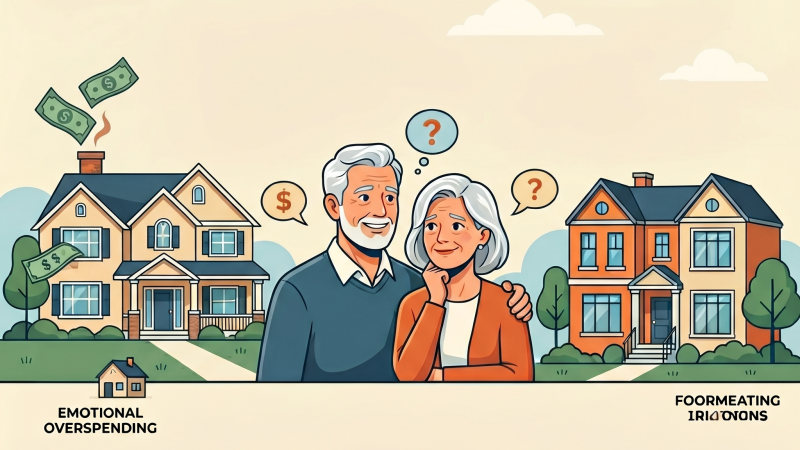
You’ve spent decades paying off your family home. The kids have long since moved out. Now you’re staring at a five-bedroom house — full of unused rooms, rising maintenance bills, and hundreds of thousands of dollars in equity sitting completely idle.
Downsizing sounds like the obvious answer.
And when it’s done right, it absolutely is. It can free up substantial cash, strengthen your retirement income, and leave your quality of life completely unchanged — or even better.
But when it’s done poorly? I’ve watched retirees lose hundreds of thousands of dollars, miss tax-saving opportunities worth tens of thousands more, and end up in homes that turned out to be completely wrong for them.
The difference usually comes down to a handful of avoidable mistakes. Here’s every single one of them.
1. Moving Somewhere You’ve Never Actually Lived
This is the romantic one. The sea change. The tree change. You’ll sell up and move to the coast, or head north to Queensland, or try that relaxed beachside town you loved on holidays.
The problem is that a holiday destination and a place to actually build your life are two very different things.
When you visit, you’re relaxed, you’re on leave, and the weather’s usually cooperating. What you don’t see is what that place is like when it rains for six weeks straight, when it’s 38 degrees every day with no relief, or when you realise you need a specialist and the nearest one is a two-hour drive away.
More importantly, you don’t have a social network there. No regular GP. No familiar shops. No coffee shop where the barista already knows your order. No community built over years.
Loneliness and mental health are as important to a successful retirement as your investment returns. Sea change regret is incredibly common — far more common than most people expect. The research on this is consistent: social connection in retirement is one of the strongest predictors of both health and happiness. Moving away from your entire support system, voluntarily, is a significant risk.
2. Changing Suburbs When You Don’t Have To
This one needs some nuance, because a lot of people assume that downsizing necessarily means uprooting.
It doesn’t.
You can usually release equity and right-size your home without leaving the suburb you’ve called home for 20 or 30 years. The same GP. The same coffee shop. The same post office. The same friends who don’t need to travel to see you.
A smaller property in your existing suburb — even one that isn’t perfect in every way — will often serve your retirement better than a bigger, nicer place somewhere you don’t know anyone.
People rarely maintain friendships across long distances once they’ve moved. It happens, but it takes consistent, deliberate effort that most people underestimate. Proximity matters. The best downsizing move, for most people, is quite literally just down the street.
3. Moving Into the Holiday House
The Mornington Peninsula weekender. The Barossa Valley cottage. The surf shack you’ve had for 20 years. These places feel like paradise — because you visit them when you’re on holiday, with family around, everyone relaxed and having fun.
Full-time living is a completely different experience.
Most holiday homes aren’t designed or equipped for everyday life. Heating and cooling may be inadequate for year-round use. Access to trades, essential services, and hospitals can be significantly more limited than you’re used to. Local communities in popular holiday areas are often transient — people come and go with the seasons, which makes it genuinely hard to build the kind of stable social network retirement requires.
And practically, moving into your weekender usually means you need to keep something in the city too, which can cost thousands of dollars per year and largely defeats the purpose of downsizing.
Then comes the renovation impulse. Almost everyone who moves into a new home — whether it’s their holiday house or not — wants to put their stamp on it. Those renovations cost real money, and they have a real impact on your retirement income.
4. Upsizing By Accident
This one surprises people because it can happen without you quite realising it.
You sell the $2 million family home. You want to move to a slightly better suburb, or a slightly nicer apartment, or you just don’t want to feel like you’ve downgraded. So you buy something for $1.8 million, feeling pleased that you’ve released $200,000.
But then you factor in stamp duty and legal costs — which can run as high as 10% of the purchase price. Then you renovate to make it feel like home. Then you realise the suburb is quieter than expected and the community isn’t what you imagined.
The point of downsizing is to release equity, not spend it. Before you sign anything, be ruthlessly clear about the actual net cash you will walk away with after every cost is accounted for. That number is what matters, not the headline difference between sale price and purchase price.
5. Not Trying Before You Buy
If you’ve owned your home for 30 years, you might not have rented since your 20s. A lot of people forget that renting is an option — and a valuable one — as a transitional strategy before committing to a new property.
Say you’re considering moving from your family home into an apartment. That’s a significant lifestyle shift. Are you ready for strata living? For hearing neighbours through the walls? For Airbnb guests in the lift? For body corporate politics that can consume more energy than you’d ever expect?
The only reliable way to know is to actually try it. Rent an apartment for three to twelve months before you sell and commit. It costs money in the short term, but it’s far cheaper than buying the wrong property and realising your mistake after settlement.
This also applies to location. If you’re genuinely considering a sea or tree change, rent for a year in that place across all four seasons before you sell your existing home. You’ll know very quickly whether it’s right for you.
6. Holding On Too Long
There are two versions of this mistake, and both are expensive.
The first is holding onto the family home past the point where it makes sense — usually because of the memories and emotional attachment, not because of the practical value of the property. Maintenance costs and garden upkeep increase significantly as properties age, particularly if you’re travelling or spending time away. The cost of everything scales with the size of your home. Keeping a five-bedroom house because you love what happened there, not what the house does for your life now, costs you real retirement income every single year.
The second version is holding onto a holiday home in the hope that your kids will want it one day, or as an estate planning strategy. Here’s the reality: your children are going to have very different lives to yours. They may not want it. They may not be able to maintain it. And the carrying costs of a second property — rates, insurance, maintenance, potential body corporate — are even higher than a principal residence. Every year you delay selling is another year of retirement income you’re leaving on the table.
7. Thinking Only About the House You Need Today
Most people downsize into a home that suits them now — their 60s or 70s. Very few think carefully about whether that home will still suit them in their 80s.
Stairs are manageable at 65. At 85, they become a serious safety risk. A split-level layout that feels modern and interesting today can become a major obstacle to independence and safety in fifteen years.
When you’re evaluating a property, you need to be thinking about two people: who you are now, and who you’re likely to be in fifteen to twenty years. Talk to older family members and friends who are a decade or two ahead of you. Ask them what they wish they’d considered when they downsized. Their answers will be more useful than any real estate agent’s pitch.
Single-level living, wide hallways, accessible bathrooms, and proximity to healthcare aren’t things most people prioritise when they feel healthy. They become extremely important when you’re not.
8. Misunderstanding the Downsizer Contribution Rules
The downsizer contribution is a genuinely valuable strategy — but it comes with strict rules that catch a lot of people out.
To qualify, the property you’re selling must have been your principal residence for at least ten years, and you must be able to access the CGT main residence exemption on that property. Selling an investment property does not qualify, even if you’ve owned it for decades.
You also need to be at least 55 years old to contribute, and the contribution is capped at $300,000 per person (so $600,000 per couple) from the proceeds of the sale.
Critically, you must make the contribution within 90 days of settlement. Miss that window and you risk breaching your non-concessional contribution cap.
But here’s the big tip that most people miss: if your super balance is already under $2 million and you haven’t maxed out your non-concessional contribution cap ($120,000 per person per year), you may not need to use the downsizer at all. You may be able to contribute up to $360,000 each (potentially $390,000 each from 1 July 2026) from the sale proceeds anyway, using standard non-concessional contributions.
Why does this matter? Because the downsizer contribution can only be used once in your lifetime. If you use it now when you didn’t need to, it’s gone — and it might have been far more valuable when you sell again in fifteen or twenty years.
The downsizer’s real benefit is for those with super balances over $2 million, because it sits outside the total super balance cap. It also has no upper age limit, unlike standard contributions. But note: it doesn’t change your transfer balance cap, so it won’t necessarily allow you to get more into pension phase.
9. Ignoring the Impact on Your Age Pension
This is one of the most financially damaging mistakes on this list, and it’s one of the least understood.
Your family home is exempt from the assets test for the age pension. The cash you free up by selling it is not.
If you downsize and release $500,000 in equity — whether that money goes into a savings account, an investment, or superannuation — it becomes assessable under the assets test. Depending on your existing situation, this could reduce your pension entitlement significantly. In some cases, a large enough downsizing can eliminate your pension entitlement entirely.
This is a situation where the financial cost of not getting advice is very real. The interaction between property, super, and the age pension is complex, and the numbers can move quickly. A good financial adviser can model the exact impact before you make any decision.
10. Forgetting to Update Your Will
This one doesn’t get talked about enough — but it causes real problems for families.
When you change your assets, your will needs to reflect the new reality. If your will specifies that a particular property goes to a particular person, and you’ve sold that property, the provision becomes void. If you’ve split property between children and now that property no longer exists, your intentions may not be carried out.
More specifically, if you’re adding money to superannuation as part of a downsizing strategy, remember that super is a non-estate asset. It does not automatically flow through your will. It goes to whoever is named as your binding death benefit nomination — which is a completely separate document that also needs to be kept current.
Review your will every time your assets change significantly. At minimum, review it every three years.
The Bottom Line on Downsizing in Retirement
Downsizing is one of the most powerful levers available to retirees who want to strengthen their financial position — but only when it’s approached with the right combination of financial strategy, lifestyle planning, and long-term thinking.
The biggest mistakes aren’t really about property. They’re about making decisions based on emotion, short-term thinking, or incomplete information. The retirees who downsize well are the ones who treat it as a strategic decision, not just a housing one.
If you’re approaching this, get advice before you act. The decisions you make in this phase have a long tail — they’ll affect your income, your pension, your tax position, and your quality of life for the next twenty or thirty years.
Have questions about your specific situation? Reach out — I’d be glad to help you think it through.
